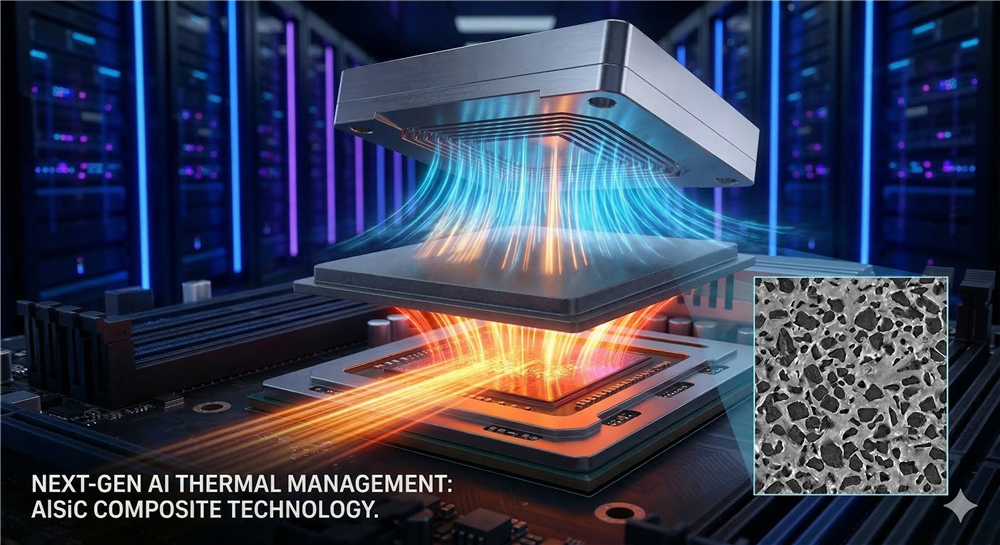
Navigating the AI Era: Ultrasonic Machining x Aluminum Silicon Carbide (AlSiC)
Why Do We Need Aluminum Silicon Carbide (AlSiC)?
The phenomenal growth in the demand of AI compute generates immense heat, pushing traditional thermal materials to their limits.
The key to unlocking higher computing power lies in mastering the Coefficient of Thermal Expansion (CTE). The significant CTE mismatch between traditional materials (such as Copper) and silicon chips induces extreme thermal stress during non-stop power cycling. This tearing force is the exact root cause of Chip Cracks and Thermal Failures, devastating the yield and reliability of advanced packaging.
Boasting a perfect blend of lightweight design, superior thermal conductivity, and exceptional rigidity, Aluminum Silicon Carbide (AlSiC) is rising as the Savior in next-generation advanced thermal management and semiconductor packaging!
What is Aluminum Silicon Carbide (AlSiC)?
Aluminum Silicon Carbide (AlSiC) combines the excellent thermal conductivity of aluminum with the high rigidity, high heat resistance, and low thermal expansion coefficient of silicon carbide. Therefore, it possesses both the thermal conductivity, ductility, and formability of metallic materials, as well as the high hardness, rigidity, and thermal stability of ceramic materials.
The unique material properties of AlSiC make it suitable for high-end semiconductor applications. For example, good thermal conductivity helps quickly dissipate heat generated during chip operation; high rigidity allows the material to maintain structural stability even in high-temperature or intense thermal cycling environments; the material’s density is only one-third that of copper (the mainstream material currently used for flip-chip heat spreaders), making it advantageous for lightweight designs in high-end packaging modules.
|
Features
|
AlSiC
|
Copper
|
|
Coeff. of Thermal Expansion
(CTE) (ppm/°C)
|
Customizable: 4.0 ~ 9.0
*Close to Silicon: 2.3 ~ 4.2
|
17.0
|
|
Material Density
(g/cm³)
|
2.9 ~ 3.0
|
8.9
|
What are the Machining Challenges of AlSiC?
Composition of Two Materials
AlSiC is a composite material composed of a soft aluminum matrix and hard silicon carbide particles. The aluminum is soft and easy to cut, while the silicon carbide is hard and brittle. This heterogeneous structure is prone to cracking or microcracks during cutting. It also produces varying cutting resistance, leading to tool damage and a rough workpiece surface.
Ultra Hardness and Tool Wear
Due to the ultra hardness of silicon carbide particles in AlSiC, cutting tools wear out very quickly, shortening tool life and increasing processing costs. Moreover, the chips produced during cutting contain fractured SiC particles, which hinder chip evacuation and tool cooling. This not only accelerates tool wear but also affects the surface quality of the workpiece.

(Figure 1. HIT ultrasonic process solution applied to rough grinding of Aluminum Silicon Carbide (AlSiC) flip-chip lid)
Hantop Intelligence's Ultrasonic Processing Solution
Proven by Global Customers, your Secret Weapon
👍🏻 Improve chip evacuation.
👍🏻 Reduce processing time.
👍🏻 Longer tool life, lower surface roughness.
👍🏻 Superior Outcomes and Cost Efficiency
📧 Contact Us for AlSiC Ultrasonic processing solutions!