Semiconductor Quartz Glass: Quartz Glass Miicro-drilling

even after 2,100 drilled holes. Polariscope inspection also confirms zero residual internal stress.

☑️ Quartz Glass Micro-Drilling: Machining Pain Points 


Quartz glass features a low coefficient of thermal expansion (CTE) and excellent heat resistance, maintaining material stability even under severe temperature fluctuations. It is highly chemically stable and resists corrosion from highly concentrated acids. While it boasts high compressive strength, it is also inherently hard and brittle.

Quartz glass micro-hole components are widely used in semiconductor, biomedical, and optical equipment. Precise micro-holes are crucial for enhancing microfluidic control and overall component performance.

However, when micro-drilling such hard and brittle materials, excessive downward thrust force easily causes severe micro-chipping and cracking on the hole edges and walls—particularly at the exit. This deforms the hole and compromises structural strength. As a result, conventional machining requires a complex post-etching process to remove these chipped edges. The more severe the chipping, the longer the etching time, wasting both labor and energy.


☑️ Quartz Glass Micro-Drilling: Machining Information 

 
Machining Information
  Material   Quartz Glass
  Feature   Φ0.44 x L4.5 mm (blind holes)
  Process   Drilling
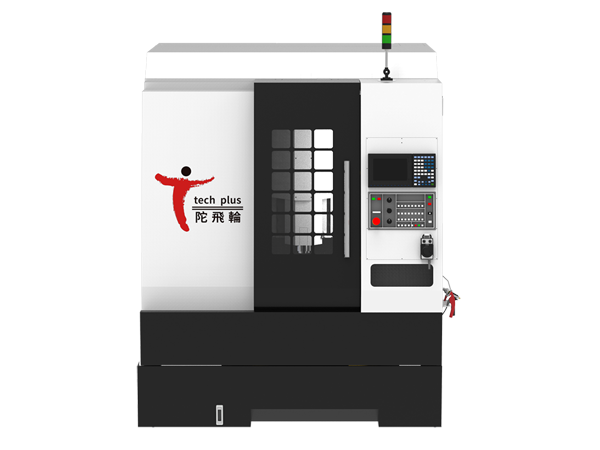
  Machine   Tech Plus Precision Machinery_DB-5H
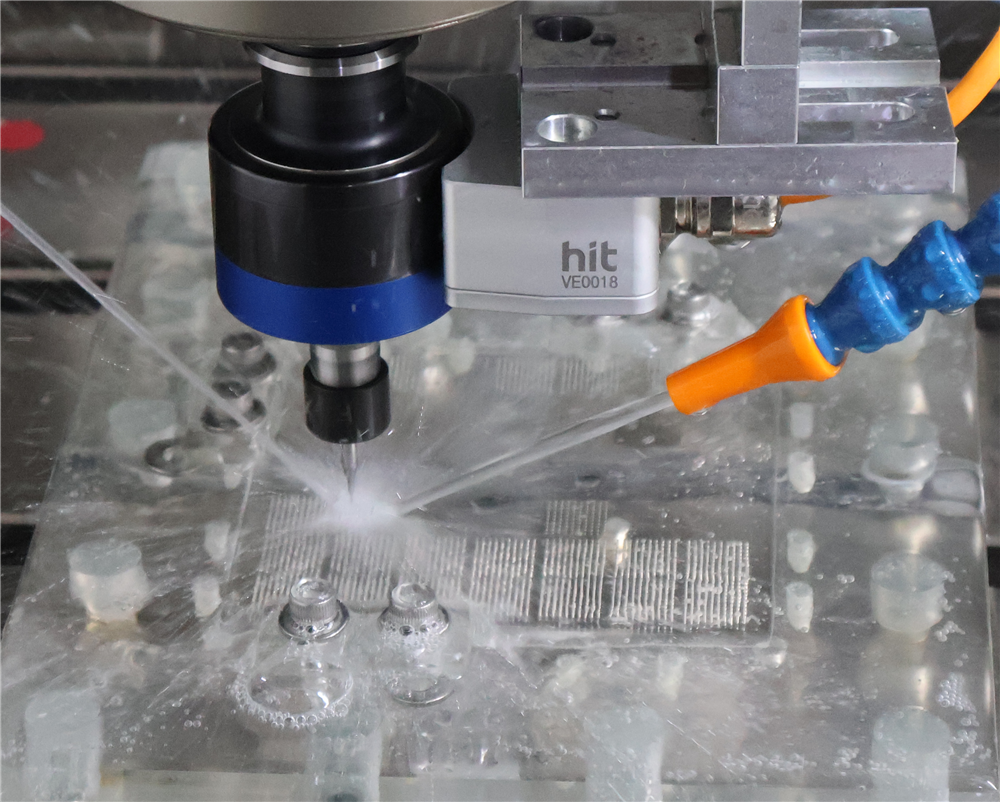
  Ultrasonic Tool Holder   HIT HSK-E32 SK06
  Tool Selection   Auto-Drill Technology PCD Drill


(Fig. 1. Machine used: Tech Plus Precision Machinery DB-5H )


☑️ Quartz Glass Micro-Drilling: Machining Parameters 

 
  Cutter Spindle Speed
(S: rpm)
Feed Rate
(F: mm/min)
G83 Peck Drilling
(Q:mm)
Drilling Depth
(mm)
Ultrasonic Power(%)
(%)
Machining Time
(秒/每孔)
Tool Life
Pilot Drilling
Parameters
Ø0.44 mm
PCD 定位鑽頭
15,000 rpm 5 mm/min 0.05 mm 0.1 mm 14%    
Main Drilling
Parameters
Ø0.44 mm
PCD 主鑽頭
15,000 rpm 15 mm/min 0.2 mm 4.5 mm 14% 60 秒/孔 2100孔
(刀具狀態依然良好)


(Fig. 2. Quartz glass micro-drilling assisted by the Hantop HSK-E32 ultrasonic module)
 

(Fig. 3. Quartz glass workpiece micro-drilling with Hantop ultrasonic assistance)


☑️ Quartz Glass Micro-Drilling: Machining Results 


Machining Results: Drilled Hole Diameter Quality

 
After testing 2,100 holes, the hole quality remains stable.


Machining Results: Hole Entrance Chipping

 
After drilling 2,100 holes, ultrasonic-assisted machining effectively
reduces edge chipping at the hole entrance.


Machining Results: Stress Response

 
Polariscope inspection shows no internal stress.


yes  Using hit ultrasonic-assisted machining ensures stable drilling quality. Even after completing 2,100 holes, the hole quality remains highly consistent, and edge chipping is effectively reduced. 

yes Furthermore, inspection under a polariscope also shows no residual internal stress. 

☑️ Quartz Glass Micro-Drilling: Industrial Applications 


Thanks to its exceptional physical and chemical properties, quartz glass plays a crucial role in modern high-tech manufacturing. Featuring an extremely low coefficient of thermal expansion (CTE) and excellent heat resistance, it maintains dimensional stability even under extreme temperature fluctuations. Additionally, it boasts high chemical stability, acid and alkali corrosion resistance, and outstanding optical transmittance. However, its high compressive strength also makes it highly hard and brittle, making high-precision micro-drilling the essential technology to unlock its full material potential.

In the semiconductor industry, quartz glass micro-drilling is indispensable. As semiconductor processes continuously shrink to the nanoscale, equipment demands increasingly stringent purity, heat resistance, and precision for its components. Precision micro-drilled quartz glass is commonly used to manufacture critical consumables and equipment parts in wafer processing. Key applications include:

  • Showerheads: For uniform gas distribution.

  • Quartz Rings: Used in the etching process.

  • Advanced Wafer Carriers

  • Microfluidic Chips

These quartz components, featuring precision micro-holes, accurately control the flow of chemical gases or liquids while withstanding the high-temperature and highly corrosive environments within the chamber. They are crucial to ensuring high yield rates and production stability in advanced semiconductor manufacturing.


Hantop's ultrasonic machining module provides a brand-new solution for machining new materials!


💡 Learn more about other HIT Ultrasonic Machining of Semiconductor Advanced Material case studies: