Semiconductor Curved Surface (Rough) Grinding of Silicon Carbide (SiC)

🕜 Efficiency - 3x higher | 📈 Quality - 1.4x better
  • Difficulties in Machining
  • HIT Achievements
  • Industry Application
  • Back to list

What makes Silicon Carbide (SiC) difficult to machine?


SiC (Silicon Carbide) has a Mohs hardness rating of 9, and it is an exceptional material choice for high-precision mechanical components.

This material bears excellent chemical and mechanical stability with high-temperature and thermal shock resistance, which also makes it an ideal material for semiconductor fabrication commodities, such as SiC substrates, SiC wafer susceptors, SiC wafer carriers, SiC E-chucks, etc.

However, due to the high hardness and brittleness of silicon carbide, the risk of grinding SiC resides in poor surface and edge quality with massive size of chipping and edge-cracks.  If the grinding force are not well-controlled during the process, the process would be extremely time-consuming with poor workpiece quality.


☑️ Curved Surface (Rough) Grinding of Silicon Carbide (SiC): Machining Information

 
    Curved Surface (Rough) Grinding of Silicon Carbide (SiC): Machining Information     
  Material   Sintered SiC
  Feature   Curved Surface (Rough) Grinding: Layered, ball-shaped grinding
  Ultrasonic Tool Holder           HSKE40-R02-06


📧 Contact Us for Ultrasonic Process Solution for SiC Curved Surface (Rough) Grinding!


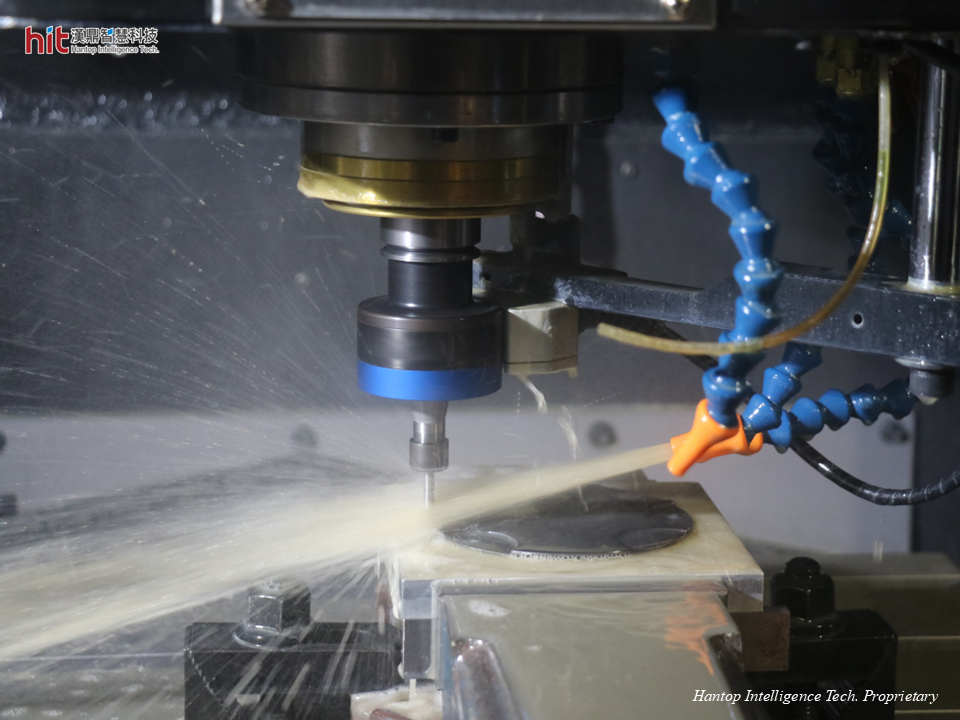
(Figure 1. HIT ultrasonic process solution applied to curved surface rough grinding of Silicon Carbide SiC)


HIT's Goal in Curved Surface (Rough) Grinding of Silicon Carbide (SiC)


Through the assistance of HIT ultrasonic-assisted machining technology, the goal is to reduce the total process time, while increasing workpiece quality by reducing the size of edge-cracks on the SiC workpiece.


Ultrasonic-Assisted Curved Surface (Rough) Grinding of Silicon Carbide (SiC): Machining Results


Curved Surface (Rough) Grinding of Silicon Carbide (SiC): Machining Efficiency
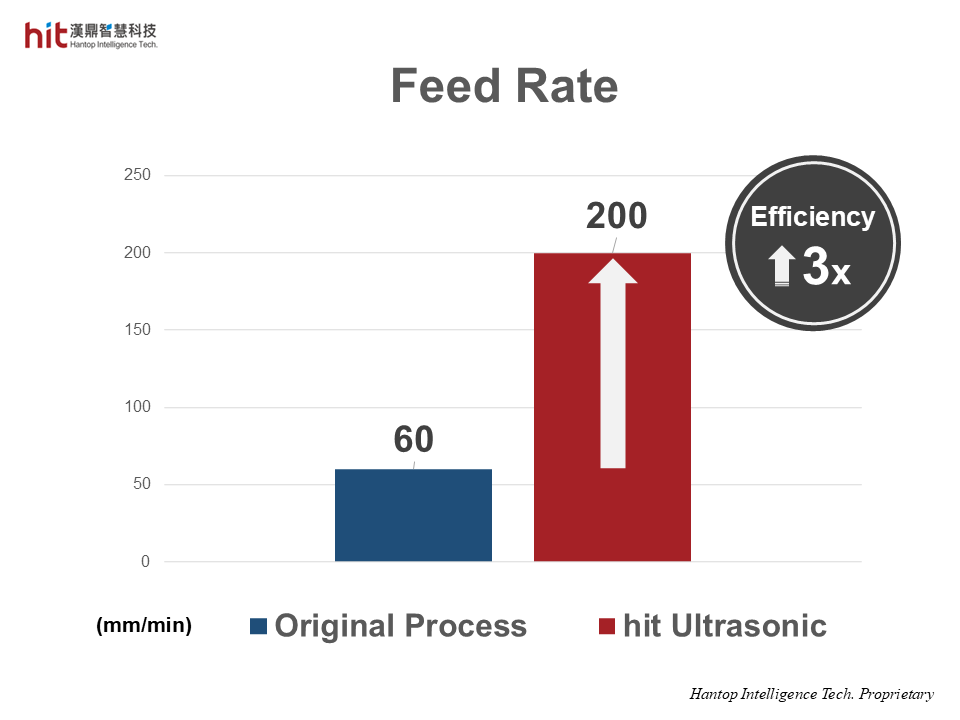
HIT ultrasonic-assisted curved surface rough grinding of SiC brought 3x higher machining efficiency by increasing feed rate
(Figure 2. HIT ultrasonic-assisted curved surface rough grinding of SiC brought 3x higher machining efficiency by increasing feed rate)


Adopting HIT Ultrasonic Process Solution for Rough Grinding of SiC
  • With HIT ultrasonic, the high frequency micro-vibration helped reduce grinding force.
  • This allowed for enhancement in the machining parameters.  The machining efficiency was increased after raising the feed rate 3x higher than the original process.


Curved Surface (Rough) Grinding of Silicon Carbide (SiC): Workpiece Quality
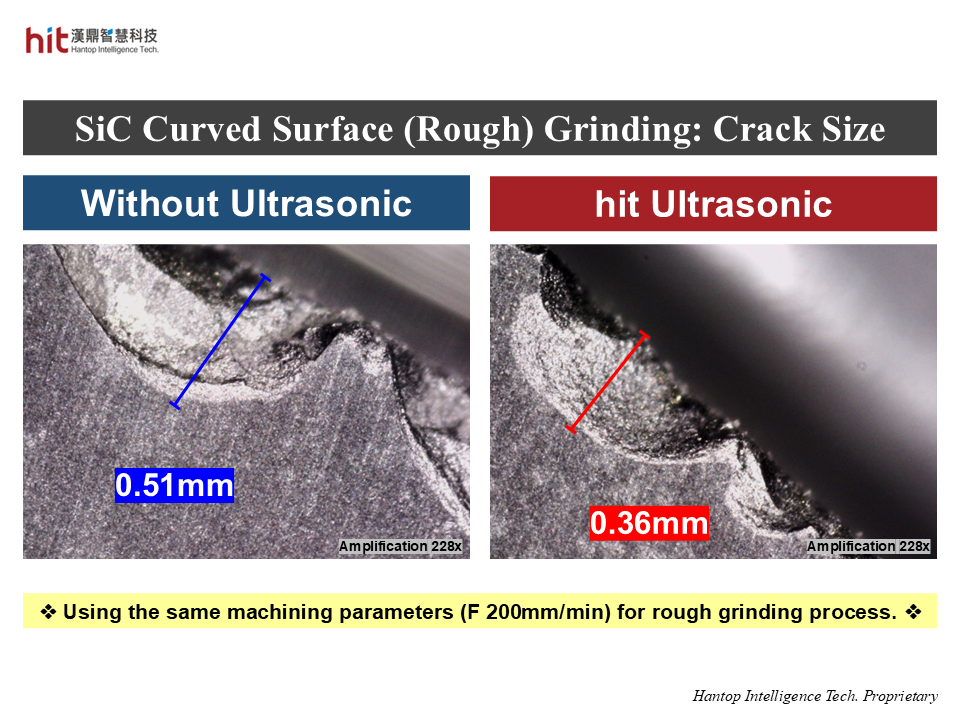
HIT ultrasonic-assisted curved surface rough grinding of SiC helped reduce size of edge-cracks on the workpiece
(Figure 3. HIT ultrasonic-assisted curved surface rough grinding of SiC helped reduce size of edge-cracks on the workpiece)
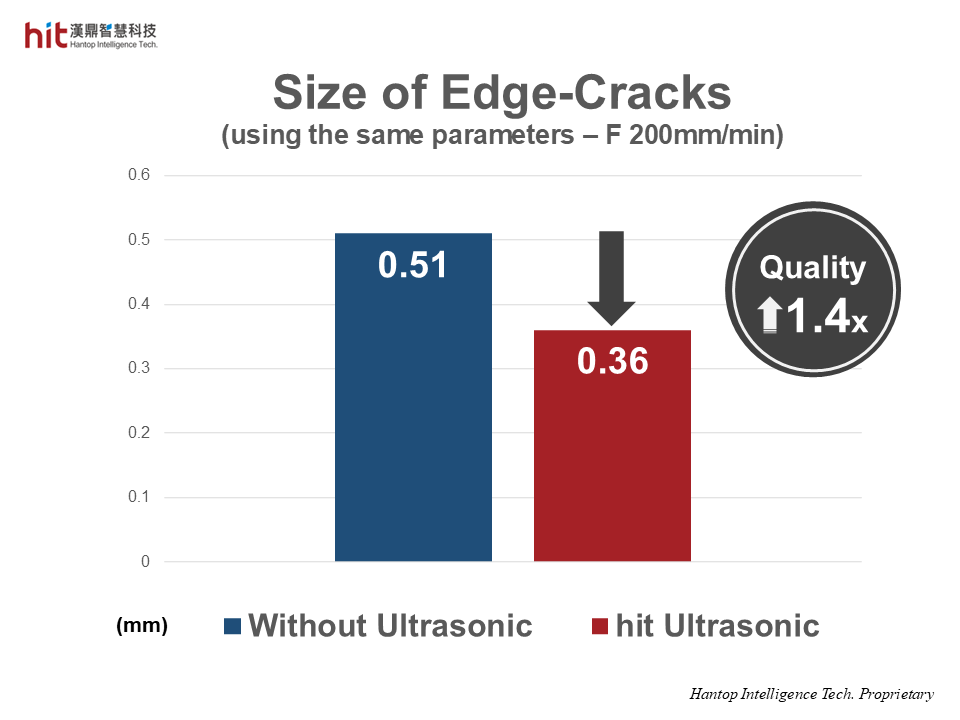

HIT ultrasonic-assisted curved surface rough grinding of SiC brought better workpiece quality with smaller edge-cracks than that without ultrasonic
(Figure 4. HIT ultrasonic-assisted curved surface rough grinding of SiC brought better workpiece quality with smaller edge-cracks than that without ultrasonic)

 
  • The reduction in grinding force helped control and reduce the size of edge-cracks on the SiC workpiece, which resulted in an improvement in workpiece quality.
  • The crack size was 1.4x smaller than that without ultrasonic under the same machining parameters (F 200mm/min).


HIT Ultrasonic Machining Technology Achievements in Curved Surface (Rough) Grinding of Silicon Carbide (SiC)


🕜 Efficiency - 3x higher (enhancement of feed rate)
📈 Quality -
1.4x better (smaller edge-cracks)


Contact us now for an Ultrasonic Process Solution for SiC Curved Surface (Rough) Grinding,
or visit HIT's booth Q5344 at SEMICON Taiwan 2025 to learn more!


Curved Surface (Rough) Grinding of Silicon Carbide (SiC): Industry Application


Grinding of SiC (Silicon Carbide) is applied in the Semiconductor industry, especially for SiC wafer susceptors, SiC wafer carriers, SiC E-chucks (electrostatic chucks), etc. as key semiconductor manufacturing components within MOCVD, etching, thin-flim processes.


SiC (Silicon Carbide) has a Mohs hardness rating of 9, and it is an exceptional material choice for high-precision mechanical components.

This material bears excellent chemical and mechanical stability with high-temperature and thermal shock resistance, which also makes it an ideal material for semiconductor fabrication commodities, such as SiC substrates, SiC wafer susceptors, SiC wafer carriers, SiC E-chucks, etc.  Since the stability of manufacturing process and product quality, as well as yield rate are all highly valued in the semiconductor industry, the chamber components which have direct contact with the wafer often have extremely high and strict standards on its product quality. 

However, due to the high hardness and brittleness of silicon carbide, the risk of grinding SiC resides in poor surface and edge quality with massive size of chipping and edge-cracks.  If the grinding forces are not well-controlled during the process, the process would be extremely time-consuming with poor workpiece quality.


That was when HIT's Ultrasonic Machining Module came to help!  HIT offers a comprehensive solution in machining advanced materials.  With the assistance of HIT's Ultrasonic Machining Technology, clients stopped worrying about poor workpiece quality while trying to speed up the processing time.  The machining efficiency can be greatly enhanced while improving workpiece quality with less edge-cracks.  HIT assures its clients of not only matching up with their requirements, but also achieving even better outcomes!


💡 Learn more about other HIT Ultrasonic Machining of Semiconductor Advanced Material case studies: 


💡 Introduction on HIT Ultrasonic Machining on advanced materials: 

📣 Welcome to visit HIT's booth Q5344 at SEMICON Taiwan 2025 to learn more about ultrasonic machining products!